How to Avoid Tension Playing Piano | Penelope Roskell

£19.99

  • 🎹 Taught by Penelope Roskell – Professor of Piano Pedagogy Trinity Laban Conservatoire
  • 🎶 Prevent Injury – Medically informed, Chair of EPTA UK
  • 🔑 Use Multiple Apps to Support Practice Routines – 5 Apps help daily routines

….  View More

What You'll Learn

How to Avoid Tension Playing Piano, with Professor Penelope Roskell


Developed in collaboration with Professor Penelope Roskell and the Roskell Academy

Why Study This Avoid Tension Piano Course for Improvisers, Teachers, Pianists, Organists and Harpsichordists?

Tension is the single most common cause of pianists’ pain — and almost nobody was ever taught how to spot it, let alone release it. This course fixes that.

Penelope Roskell — Professor of Piano and Piano Pedagogy at Trinity Laban, Chair of EPTA UK, and Piano Advisor to BAPAM (the British Association for Performing Arts Medicine) — is the UK’s foremost specialist in pianists’ injury prevention, with over thirty years in the field and the award-winning The Complete Pianist to her name. In this course, created especially for improvisers and keyboard players of every kind, she shows you how to play with a free, effortless technique that produces a warmer sound and protects you for the long term.

This is not “cranky” technique or a set of rigid rules. It is a research-grounded, physically intelligent approach to how the hand, wrist and arm actually work at the keyboard — and how to teach that freedom to your own pupils.

What Will You Learn About Piano and Avoiding Wrist Pain?

  • Read your own playing. Record yourself and learn to see visible tension and hear the dry, thin or harsh sound it produces — in yourself and in your pupils.
  • Free the wrist. Simple, repeatable checks — drop tests, circles, the “breathing wrist” — that release the tension most players don’t know they’re carrying.
  • The parachute touch. Use arm weight and gravity, not finger force, to drop effortlessly onto single notes, thirds and full chords for a true cantabile sound.
  • Walking legato. Transfer weight note-to-note with a breathing wrist for genuinely connected, singing phrases.
  • Practise without injury. Break patterns, gradual increases, and why endless loud, mindless repetition harms both artistry and hands.

Every lesson pairs video instruction from Penelope with an interactive app you can keep open on the instrument — including the Drop Trainer, which lets you feel the parachute touch across different keyboard resistances (piano, organ and harpsichord actions alike), and the Anti-Tension Practice App, a structured map that you can work through against whatever piece you or your pupil are learning.

There are 6 mini-apps in total:

  • Record Reflect App
  • Force Illusion App
  • Body Mapping App
  • Drop Trainer App
  • Walking Legato App
  • Anti Tension Practice Companion App

Who Should Study Avoiding Tension Playing Piano?

This course meets you wherever you are — from your very first year at the keyboard to a full professional career.

  • Every level: beginners, amateurs and returning players; graduates, advanced pianists and working professionals.
  • Every keyboard player: improvisers, pianists, organists and harpsichordists — in any style, classical or otherwise.
  • Every role: performers and teachers alike. Every objective is written so you can apply it both to your own playing and to what you see and hear in your pupils, making it a CPD resource you’ll return to in every lesson you give.

Organists and harpsichordists especially: tension on heavy coupled or tracker-action organs — and on the light, deceptively demanding harpsichord action — is widespread and rarely addressed. This course, and the Drop Trainer app, model those different resistances directly. On a coupled organ manual the initial key resistance takes real force, but continuing to push once the note has spoken is wasted tension travelling straight up the arm — and the parachute touch is the answer.

Frequently Asked Questions

Do I need classical training or to read music?
No. The techniques apply to whatever repertoire you or your pupils are working on, in any style. Nothing here assumes formal training or notation-reading — this course was written with improvisers in mind.

I’m a complete beginner — is this too advanced for me?
Not at all. Building free technique early is the best gift you can give yourself; you’ll avoid the habits that trouble so many players later. Equally, if you’re an advanced pianist or graduate, you’ll find the diagnostic and release work rewards a lifetime of playing.

I already teach — is there anything new here for me?
Yes. Beyond refining your own technique, the course sharpens your diagnostic eye and ear — spotting hidden tension in a pupil and knowing exactly which release to prescribe. It’s designed as much for the studio as for your own practice.

I play the organ or harpsichord, not just piano. Is this relevant?
Very. Tension problems on coupled and tracker-action organs, and on the harpsichord, are widespread and rarely taught. The course and the Drop Trainer app model these different instrument resistances directly.

I don’t have any pain — is this still useful?
Yes. This is a prevention course. Most tension injuries develop slowly, over years, from habits nobody ever corrected. The earlier you build free technique, the less likely you are to need treatment later. 

How long does it take?
The nine lessons take roughly an hour to work through, then a few minutes of applied practice each time you sit at the instrument. It’s self-paced — revisit any lesson or app whenever you need it.

Do I need a digital piano or special equipment?
No. Everything is designed for your real acoustic piano, organ or harpsichord. The apps run on any phone, tablet or computer, including iPhone and iPad.

Is this a certified or examined course?
No — it’s a self-paced instructional course, sitting alongside The Maestro Online’s Ofqual-accredited Piano Improvisation exams, our Pop Piano Exams, and as supporting technique training.

Where can I find more of Penelope’s work?
This course was created in collaboration with the  Roskell Academy, where you’ll find Penelope’s books, resources and further courses on healthy piano technique, including her award-winning The Complete Pianist.

Your Maestro Teacher


Who is Professor Penelope Roskell?

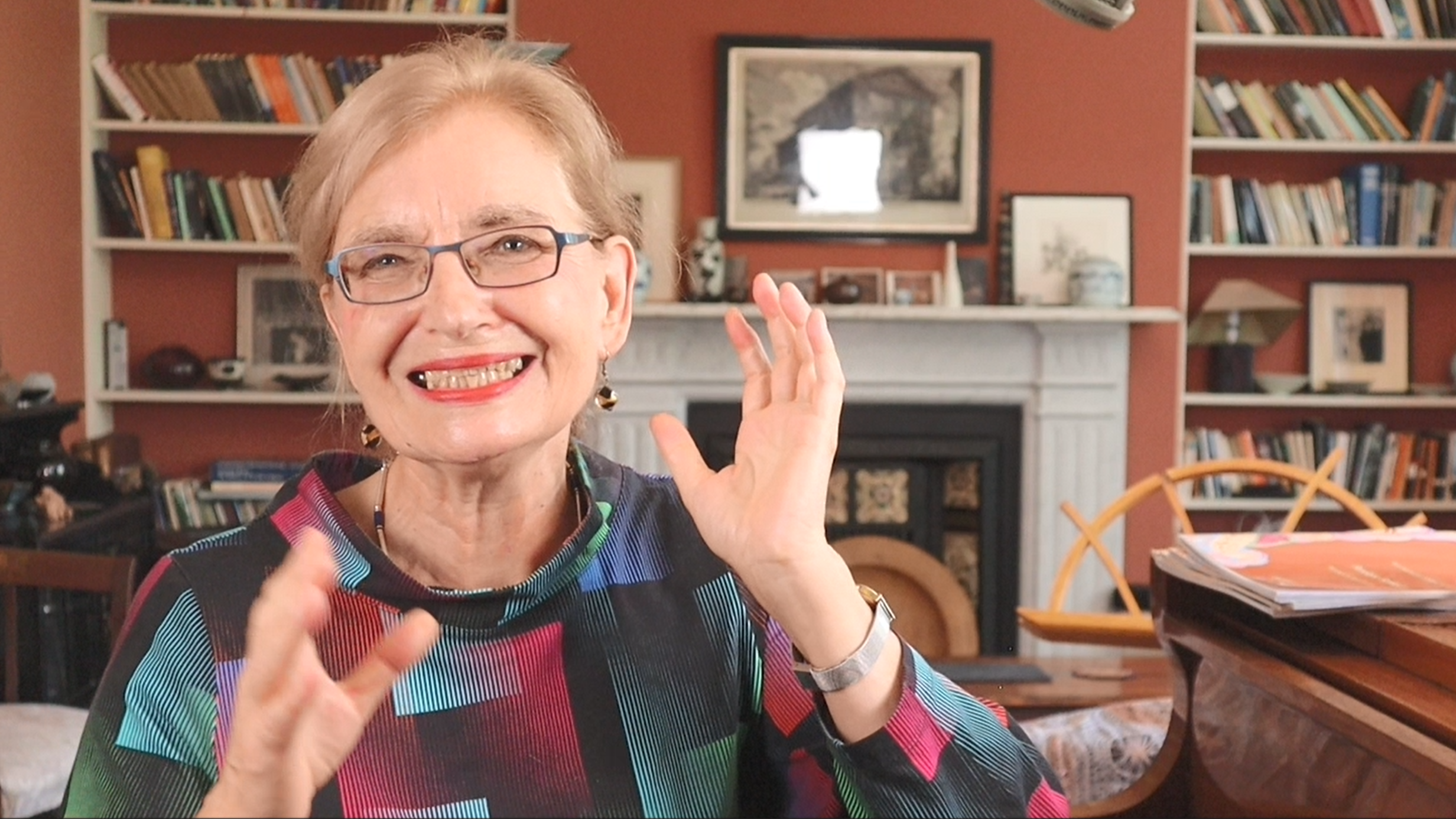
Penelope is a legend in the world of Piano Pedagogy, Professor of Piano and Piano Pedagogy at Trinity Laban Conservatoire, Chair of EPTA UK (European Piano Teachers’ Association UK), President Elect of EPTA Europe and founder of the incredible Roskell Academy, a not-for-profit piano education platform for pianists and teachers.

Penelope is the author of award-winning books ‘The Complete Pianist, from healthy technique to natural artistry’, and the ‘Essential Piano Technique’ series.

She began her career performing under Sir Simon Rattle at the age of 19.  She has performed as a concert pianist in over 35 different countries.

She serves as an official jury member for the BBC Young Musician competition, helping to evaluate and elevate the next generation of top-tier British musical talent.

Penelope serves as Piano Advisor to the British Association for Performing Arts Medicine (BAPAM), where she runs a joint clinic with a medical doctor treating pianists suffering from tension, repetitive strain, and injury.

What are Our Music Masterclasses Like?

Our music masterclass courses are self-study digital courses embedded with information, interactive music software (scores), exercises, objectives, tasks, teaching pedagogy and videos of celebrities and international level musicians explaining and demonstrating key skills. Certificates are awarded at the end of each course.

Our Platform: How do we teach and you learn?

🎵 Why Choose Our Music Learning Platform?

Unlock a rich, flexible, and inspiring music education experience designed for musicians of all levels. Whichever area of musical learning inspires you, our world-class performers offer it all.

A Quick Look at a Typical Masterclass Course

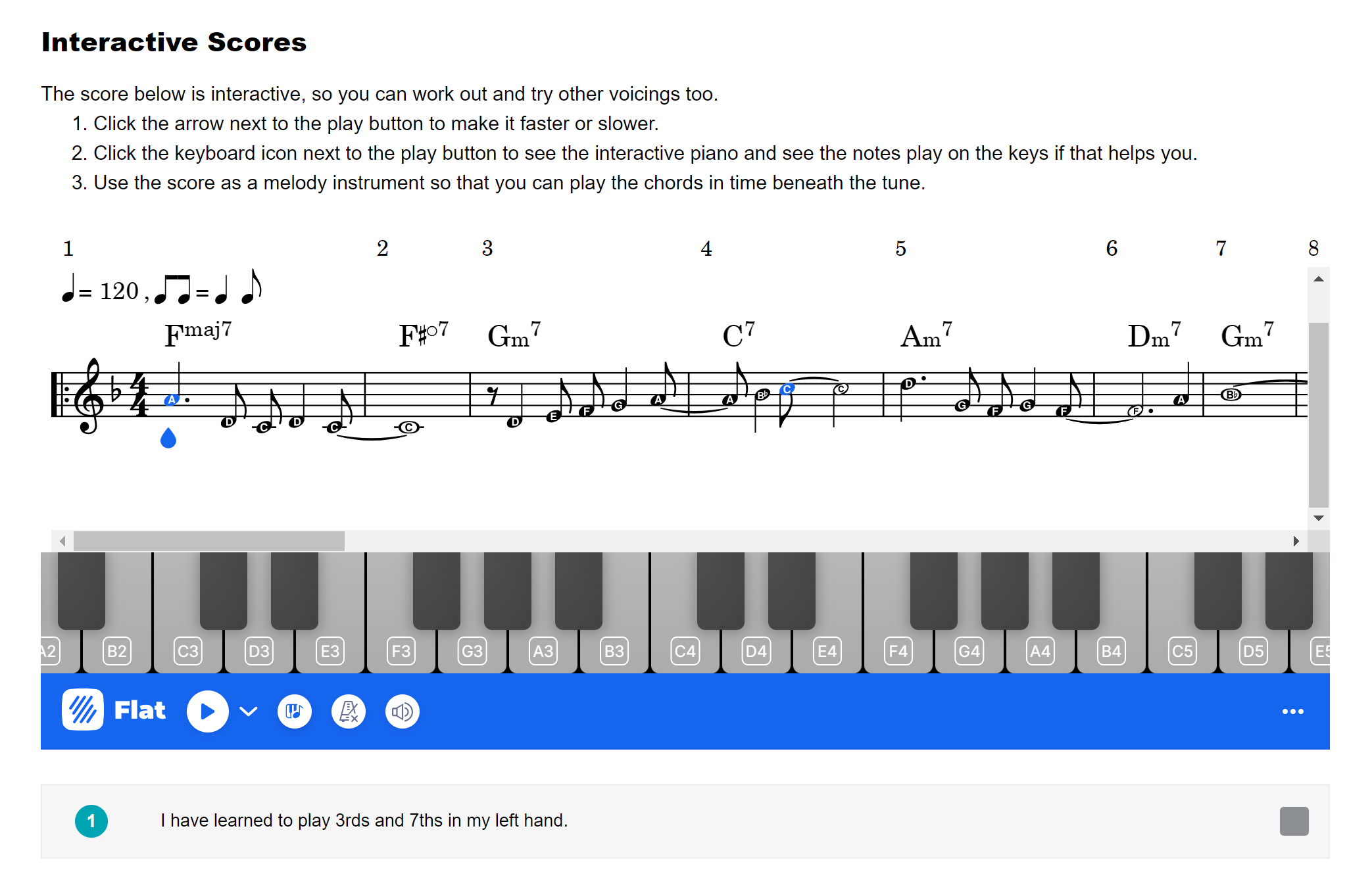
Sample Interactive Score
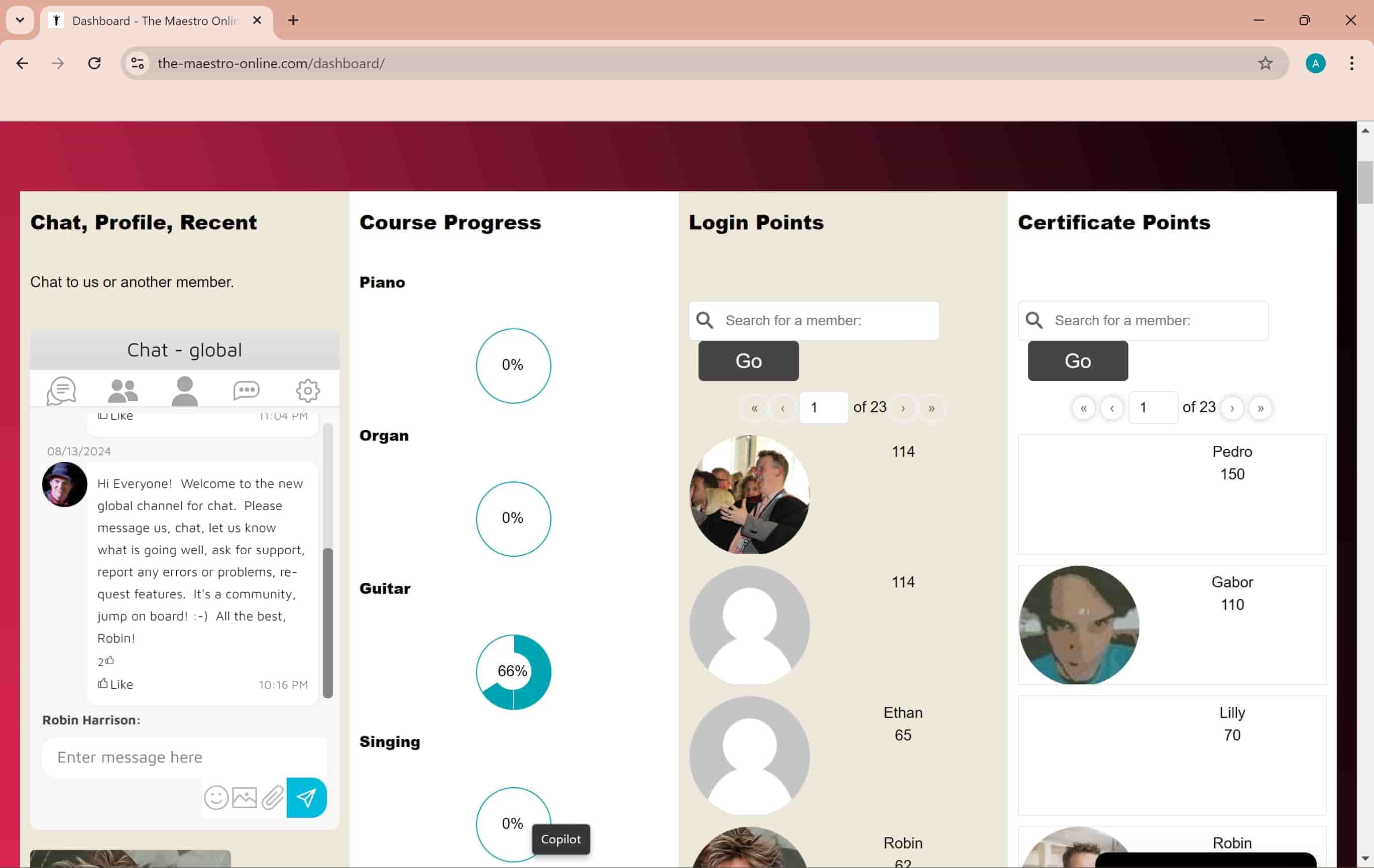
Course Dashboard with Progress and Points
 

🎼 Thorough Musicianship
Creativity, improvisation, and ear training are seamlessly integrated with popular, gospel, classical and jazz melodies to help you achieve true musical freedom.

🧠 Unique Learning Journey
Our tailored methodology emphasises improvisation and aural skills first, with notation used to support—not restrict—your creativity.

🎓 Certification
Courses include clear objectives, tasks, and fun quizzes that lead to downloadable certificates—perfect for motivation and recognition.

🎮 Gamification
Track your progress and climb the league tables by earning certificate points and logging in regularly.

🖥️ Interactive Software
Our custom music software links visual notation with sound to enhance your creativity and understanding.

📹 Celebrity Masterclasses
Learn from internationally acclaimed musicians and award-winning performers through high-quality video lessons and real-world demonstrations.

📘 Expert Pedagogy
Each self-study course is structured with professional teaching principles, goal-setting, progress tracking, and step-by-step tasks.

🏠 Flexible Learning
Study from home, at your own pace. Affordable monthly fees and no need to travel—music learning that fits your lifestyle.

🤝 Human Touch
Get personalised support from our expert team and request custom courses tailored to your goals.

🎯 Personalised Experience
Receive bespoke course recommendations and guided learning plans based on your interests and skill level.

🎹 For All Levels
A wide range of self-study courses, celebrity masterclasses, and optional 1-1 lessons designed for adult and teenage musicians, university/conservatoire students, home schoolers, and music therapists.

________________________________________

💡A Quick Look at a Typical Masterclass Course

• 🎬 Celebrity video lessons
• 📝 Objectives & exercises
• 🎯 Progress tracking
• 🖱️ Interactive music software
• 🎓 Certificate on completion

Subscribe to all Masterclasses

(over £2000 of content included)