How will I Learn to Improvise Piano Cadenzas?
Improvise piano cadenzas and free your soul! Stop memorizing and start speaking piano music! Join Dr. Bert Mooiman (Royal Conservatoire of The Hague) to master the art of the classical cadenza. Using 18th-century ‘Bel Canto’ vocal models and the 3-Part Structure method, you’ll learn to improvise flourishes that sound like Mozart or Beethoven and not a textbook. Perfect for intermediate to advanced pianists looking to reclaim their creative freedom.
Piano Cadenza Vocal Models & Historic Sources
- The Vocal Model (Bel Canto): Discover why the best piano cadenzas are actually “operatic arias for the pianist’s fingers.” Learn to breathe, pace, and ornament like a virtuoso singer.
- Harmonic Devices & Skeleton Sketches: Learn when, and how, to create cadenzas on dominant and 6/4 chords.
- Structural Frameworks: Learn the difference between a full-scale Sonata cadenza and Mozart’s Eingang (the perfect “mini-cadenza” entry point for beginners).
- Thinking in Music: Apply the “Sound-Before-Symbol” pedagogy to internalize classical vocabulary so improvisation feels as natural as conversation.
- Historical Research Driven Authenticity: Use methods and materials by Czerny, Mozart, Beethoven, Pauline Viardot, Manuel Garcia, Laure Cinti-Damoreau and Türk. These all historically significant musicians; learn from their music and historical teaching materials. You are learning from the very best.
What Will I Achieve in this Improvising Piano Cadenzas Masterclass?
- Singing, Opera & Bel Canto were at the core of popular music historically. Instrumentalists tried to copy singers and thus bel canto singing methods are an excellent resource for piano cadenza training.
- Pauline Viardot Pars Conservatoire Vocal Exercises: Pauline’s scalic, arpeggio and broken chord patterns that she used with her students in Paris. We also focused on upper/lower neighbour notes, échappées and embedded turns.
- Manuel Garcia’s Method: This led singers to rehearse sequences using 2, 3, 4, 8, 12, 16 note patterns with scalic, arpeggio etc material.
- Laure Cinti-Damoreau’s Method: Laure’s method is excellent for considering peak notes and “guide tones”.
- Thinking in the Language: Paul Berliner & Czerny
- Mozart’s Eingang – extending fermatas and elaborating dominant chords.
- The Sonata Form/”Big” Concerto Cadenzas – Elaborating a 6/4 Chord
- The Quieter Section & Prior Thematic Material (Mozart)
- The 3 Part Cadenza Structure – 1. Implied extended 6/4 chord
2. Lyrical middle section, possible surprise feature 3. Sequential excitement building to final trill - The Skeleton Sketch –Türk and his pedagogical piano method from ornaments via fermatas to short cadenzas and longer examples.
Who is this Historically Informed Piano Cadenza Masterclass for?
Perfect for: Diploma-level students, professional pianists, and ambitious learners who are tired of playing only what’s on the page.
- The Thinking Musician: Pianists, harpsichordists and organists who want to understand how music is built without getting too bogged down in abstract theory.
- Grade 6+ to Professional: Perfect for those moving beyond the first masterclass or looking to refine their improvisational “vocabulary.” Excellent for Undergraduates and Postgraduates as well as ambitious or hard-working learners.
- Perfect For: Pianists, organists and harpsichordists who want to improvise, composers (including A Level and Undergraduate or even Postgraduate), students trying our Creativity Grades exam syllabus List A – Romantic Era Route, but also great for Lists B and D of our Ofqual & EU accredited exams.
Frequently Asked Questions
Do I need to have completed Bert’s first & second masterclasses (Romantic Preludes) before starting this one?
While Masterclasses 1&2 provides an excellent foundation in basic decoration, it isn’t a strict prerequisite. If you are an upper-intermediate to advanced pianist (Grade 6+) who is comfortable with basic harmonic “skeletons,” you can dive straight into Masterclass 2 to explore advanced chordal textures and Partimento models.
Do I need to be a professional pianist to improvise cadenzas?
Not at all! While the topic sounds advanced, Bert breaks it down into “musical building blocks” or schemata. If you are an intermediate player who knows basic scales and chords, you can start using these harmonic devices to create your own flourishes.
What are “Vocal Models” in piano improvisation?
Historically, the best instrumentalists were told to “sing” through their fingers. Bert uses Bel Canto (beautiful singing) as a model for the piano. By thinking like an opera singer, your cadenzas will sound like natural, expressive melodies rather than just a series of fast scales.
What is the difference between a Cadenza and an Eingang?
A cadenza is a large-scale, dramatic improvisation usually found at the end of a concerto movement. An Eingang (German for “entrance”) is a shorter “lead-in” or mini-cadenza used to transition between sections. Bert covers both, showing you how to scale your creativity to fit the moment.
Does this course cover specific composers like Mozart or Beethoven?
Yes. The masterclass focuses on the Classical and early Romantic traditions. You’ll learn how to become a famous composers like Mozart or Beethoven, creating spontaneous, historically-informed improvisations.
How does “Sound-before-Symbol” apply here?
At The Maestro Online, we believe in internalising the music first. Instead of memorising a written-out cadenza (the symbol), Bert teaches you to “think” in the musical language of the era (the sound), allowing you to speak through the piano fluently.
Is this course very heavy on music theory?
Music Theory is barely even a topic in this masterclass. Cadenzas are mostly single-line events and 18th-19th-century masters focused on “example-based” and “pattern-based” learning. You won’t spend your time labelling secondary dominants on paper; you will learn to “respond” to the sound at the piano. The goal is to internalise the music so your hands know where to go intuitively.
Can these techniques be used for instruments other than the piano?
Yes these are perfect for organists and harpsichordists as well as pianists. In fact, these skills are essential for anyone looking to master the historical “Art of the Keyboard.”
🎵 Why Choose Our Music Learning Platform?
Unlock a rich, flexible, and inspiring music education experience designed for musicians of all levels. Whichever area of musical learning inspires you, our world-class performers offer it all.
A Quick Look at a Typical Masterclass Course
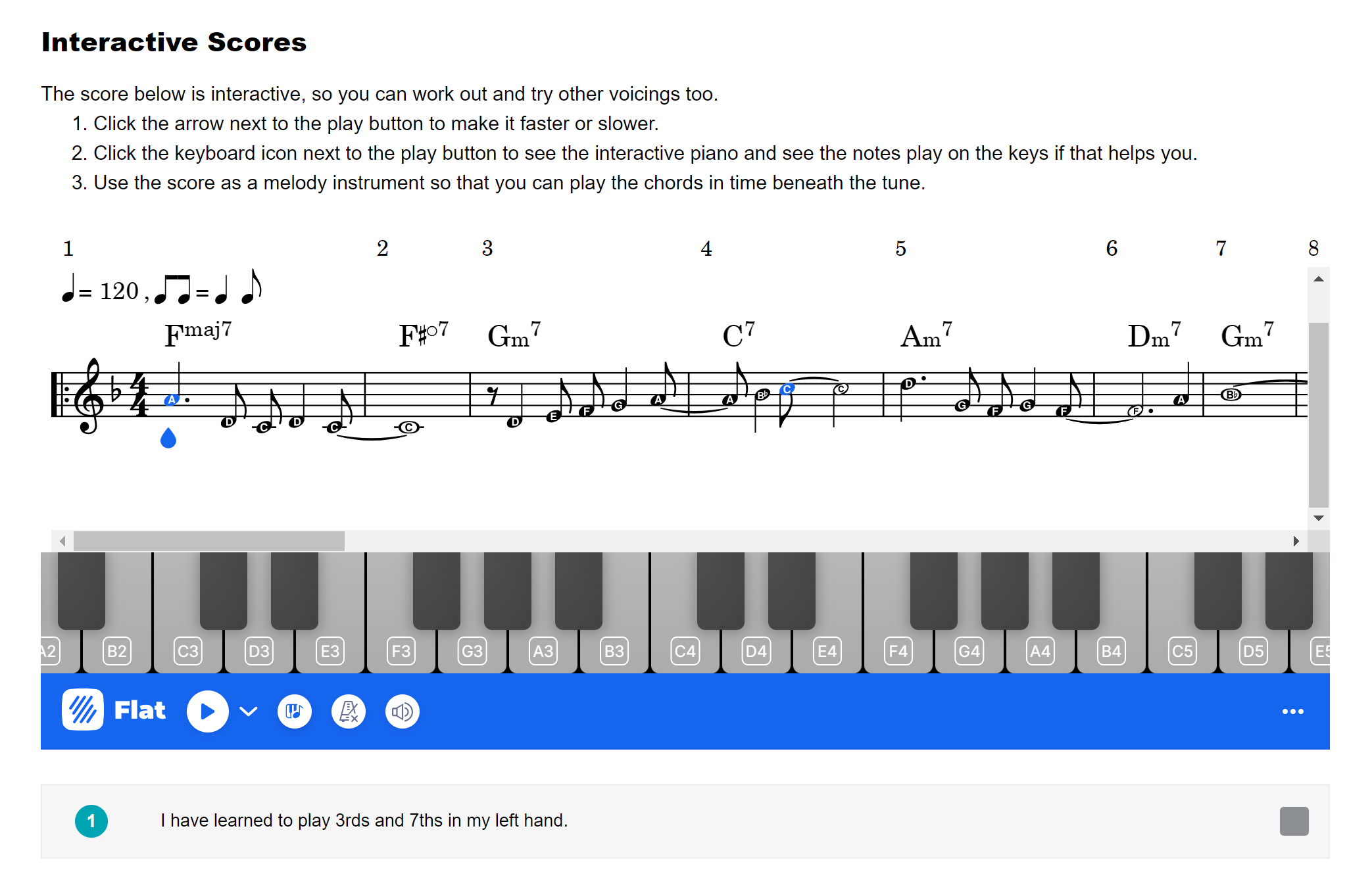
Sample Interactive Score
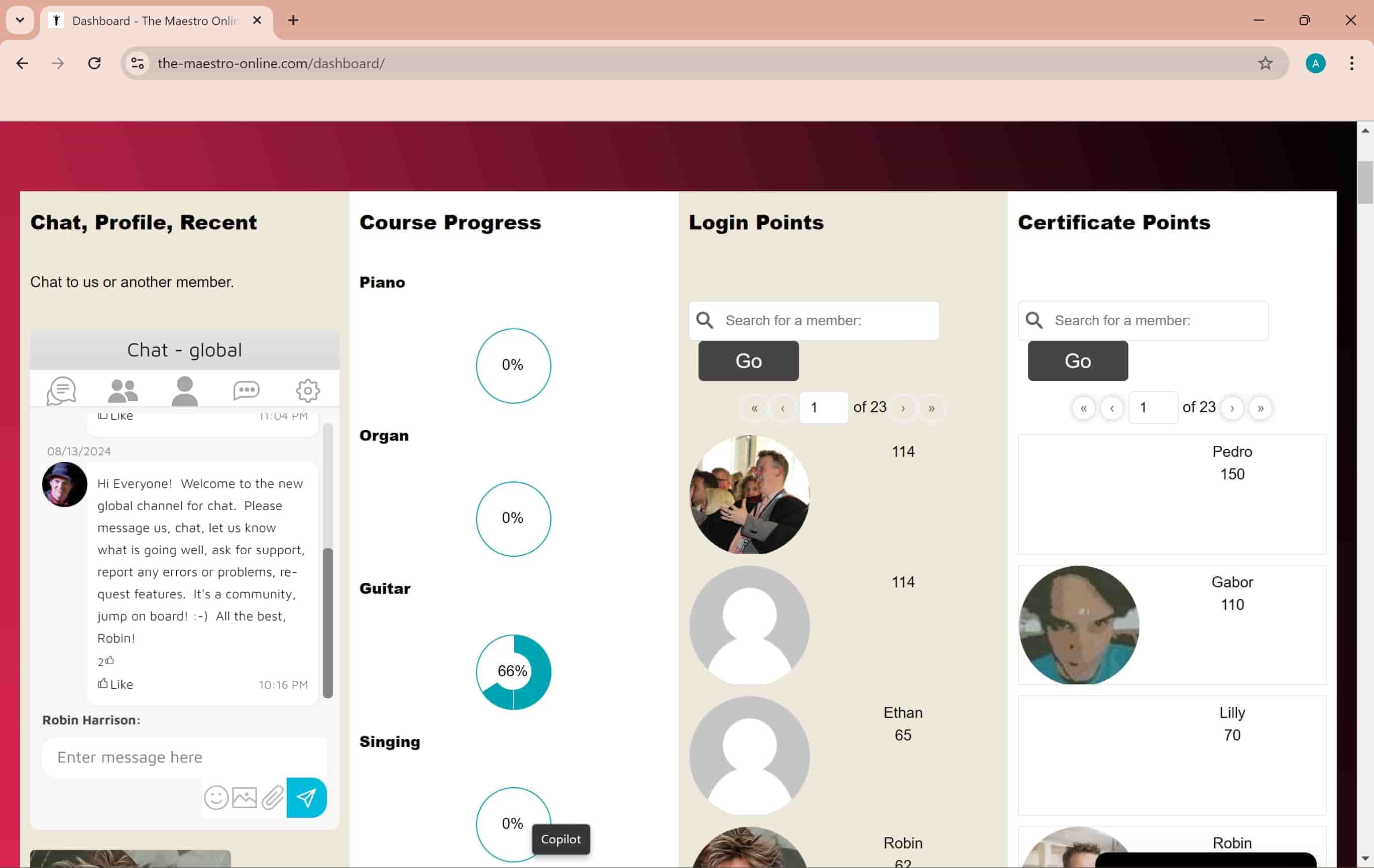
Course Dashboard with Progress and Points
 Thorough Musicianship
Creativity, improvisation, and ear training are seamlessly integrated with popular, gospel, classical and jazz melodies to help you achieve true musical freedom.
 Unique Learning Journey
Our tailored methodology emphasises improvisation and aural skills first, with notation used to support—not restrict—your creativity.
 Certification
Courses include clear objectives, tasks, and fun quizzes that lead to downloadable certificates—perfect for motivation and recognition.
 Gamification
Track your progress and climb the league tables by earning certificate points and logging in regularly.
 ️ Interactive Software
Our custom music software links visual notation with sound to enhance your creativity and understanding.
 Celebrity Masterclasses
Learn from internationally acclaimed musicians and award-winning performers through high-quality video lessons and real-world demonstrations.
 Expert Pedagogy
Each self-study course is structured with professional teaching principles, goal-setting, progress tracking, and step-by-step tasks.
 Flexible Learning
Study from home, at your own pace. Affordable monthly fees and no need to travel—music learning that fits your lifestyle.
 Human Touch
Get personalised support from our expert team and request custom courses tailored to your goals.
 Personalised Experience
Receive bespoke course recommendations and guided learning plans based on your interests and skill level.
 For All Levels
A wide range of self-study courses, celebrity masterclasses, and optional 1-1 lessons designed for adult and teenage musicians, university/conservatoire students, home schoolers, and music therapists.
______________________________
 A Quick Look at a Typical Masterclass Course
•  Celebrity video lessons
•  Objectives & exercises
• Progress tracking
•  ️ Interactive music software
• Certificate on completion

(over £2000 of content included)