A Classical Improvisation Masterclass with Douglas Finch
Not every pianist, organist or harpsichordist who wants to improvise classically is chasing a complete Sonata Form — sometimes you just want to sit down and create something convincing in the style, without it needing to go anywhere in particular. The six-gesture method taught here works just as well for that: the same physical, rhythmic and textural thinking that shapes an extended structure is exactly what makes a single improvised phrase sound intentional rather than aimless. Sonata Form is simply where the method leads if you choose to take it in that classic direction. Freedom and flow in improvisation are Douglas’s priority.
How do you Improvise Sonata Form From Just Six Gestures (Jigsaw Pieces)?
An easy route to create quality musical motifs with strong character and a quick route to sophisticated form/structure
Most pianists can play sonata form. Far fewer can improvise one. The leap from fluent technique to spontaneous, convincing classical structure is where most players stall — not because the music is too hard, but because “Sonata Form” sounds like an exam topic rather than a creative tool.
Douglas Finch’s jigsaw-piece method removes that fear entirely. Instead of starting from theory, you start from six small, deliberately contrasting gestures — a held note, a syncopated outburst, a rising fifth, a passage of silence. You then learn, piece by piece, how composers from Beethoven to Mahler actually link, develop and resolve ideas like these — and you apply each technique immediately at the keyboard.
By the end, you’re not reciting “First Subject Group, Transition, Second Subject Group.” You’re improvising a genuine three-to-four-minute sonata form, built entirely from your own musical instincts.
What Will You Learn About Classical Improvisation?
How to invent six genuinely contrasting “jigsaw piece” gestures, using physical intent, temporal shaping, dynamic contour, articulation and register as your raw materials
A full toolkit of connective techniques — silence, elision, overlap, dissolution, pedal point, sequence, retrograde and textural layering — and when to reach for each one
How to shape an Exposition, Development and Recapitulation through character and contrast rather than memorised rules
The same devices Beethoven, Mozart, Mahler and Prokofiev used to begin, develop and resolve their own sonata forms, reframed as techniques you can use today
A “pitch-centre” approach that lets you improvise convincing sonata structures whether you’re working tonally or freely
Includes The Maestro Online Mini-Apps to Support Learning
Why does Classical Improvisation Matter for the Serious Pianist
Improvisation isn’t a detour from the Classical tradition — it sits at its centre. Partimento, galant schemata and historically informed improvisation were the everyday craft of 18th-century musicians long before they became specialist research topics. This masterclass puts that craft back into your hands, in a form built for a modern pianist with modern time constraints.
It’s also directly relevant if you’re working toward The Maestro Online’s Creativity Grades: the gesture-based, connective-tissue thinking taught here underpins the Bass-Up and Free Choice improvisation lists examined at every grade.
Who This Masterclass Is For?
Advanced pianists who want to improvise convincingly in a Classical idiom, not just play from the score
What’s Inside the Classical Improvisation Masterclass?
Full video of Douglas Finch improvising and analysing his own jigsaw pieces in real time
Four creative-stimulus mini-apps: an Inspiration Image generator, a Random Gesture Selector, a Video Gesture Selector, and a literary/Elements-of-Music gesture generator
Two Development Apps: A Connective Tissue Generator and a Development Techniques Generator, covering every linking and developmental device discussed in the course
“Sonata Form Journey” apps — one graphic, one video-based — that walk you through a complete improvised structure visually and with ease
A practice-schedule tool that syncs to your calendar with a 30-minute reminder
Structured tasks that build, stage by stage, from a single gesture to a complete improvised sonata form
Why Choose This Masterclass?
Most online courses focus on theory books. This course focuses on playing. Whether you are preparing for our Creativity Grades, or just want to stop being “safe” at the piano, organ or harpsichord, these lessons provide the tools to make your music sound like you.
The Maestro Online Difference
This isn’t just a video, it’s a course with tasks, apps and interactive scores; it’s part of a holistic ecosystem. When you join, you’re not just getting a course—you’re joining a global community of creative musicians learning from the finest pianists and organists, improvisers and more in the world.
Do you struggle with flow in music? Stop thinking. Start flowing.
Bypass the “theory trap” and master the art of spontaneous creation with Professor Douglas Finch. Designed for all pianists wanting to improvise, but also with specially created aps for composers, organists, harspichordists and pianists looking to break into Film, TV, Adverts and Game scoring, this course teaches you how to translate visual energy and kinetic motion directly into professional-grade piano improvisation.
Frequently Asked Questions
Do I need perfect pitch to improvise a sonata form? No. The method works entirely through contour, gesture and contrast — Douglas Finch himself doesn’t have perfect pitch.
Is this masterclass only useful for exam candidates? No. It’s built for any pianist who wants to improvise convincingly in Classical style; the exam relevance is a bonus, not a requirement.
Do I need a background in composition or theory? No formal training is needed. The course tackles academic terminology like “First Subject Group” through readily accessible concepts such as gesture, character and contrast.
How long does it take to complete? The course is self-paced and builds toward a complete improvised sonata form of roughly three to four minutes — most pianists work through the full sequence over several weeks.
When Can I Start Piano Improvising? Today! – Just Sit and Play Piano Now!
Take the step beyond average “piano” tutorials, and let world-class Professor Douglas enable you to just “Sit and Play”.
Your Maestro Teacher
Who is Douglas Finch?
Douglas Finch is a Canadian-born pianist, composer, and renowned improviser based in the U.K., known for his ability to blend classical, contemporary, and improvised music. He is a Professor of Piano and Composition at the Trinity Laban Conservatoire of Music and Dance in London.
Improvisation can often feel like a dark art, but Douglas Finch is here to turn on the lights. Douglas has spent decades mastering the “lost art” of classical improvisation. In this third course of his series, he breaks down the fundamental building blocks of Variation Form.
Improvisation Expertise: Described as a “genius improviser” and a rare classical musician who can improvise in the moment with a deep awareness of classical history, Finch often performs and records improvised music, including collaborations with saxophonist Martin Speake.
Education and Early Career: Born in Winnipeg, Canada, he began improvising and composing at an early age. He studied at the University of Western Ontario and The Juilliard School in New York. He won a Silver Medal at the 1978 Queen Elisabeth International Competition in Brussels.
Career in the U.K.: He settled in London in 1993, where he co-founded The Continuum Ensemble in 1994, a group dedicated to premiering new works.
Composition and Film Work: Finch has composed for orchestra, chamber ensembles, and film, including scores for British director Jon Sanders, such as A Change in the Weather (2017) and A Clever Woman (2020).
Teaching and Curation: At Trinity Laban, he has directed large-scale events like the “In the MOMENT” festival of dance and music. He also teaches at Chetham’s School of Music and is known for his work in the “Psychology, Art of Improvisation & Solitude”.
Recordings: His recordings include Inner Landscapes: Piano and Chamber Music 1984-2013 and Sound Clouds (with Martin Speake).
His work is characterized by “instant composition” and a unique, personal vision that draws on diverse musical influences.
What are Our Music Masterclasses Like?
Our music masterclass courses are self-study digital courses embedded with information, interactive music software (scores), exercises, objectives, tasks, teaching pedagogy and videos of celebrities and international level musicians explaining and demonstrating key skills. Certificates are awarded at the end of each course.
Our Platform: How do we teach and you learn?
🎵 Why Choose Our Music Learning Platform?
Unlock a rich, flexible, and inspiring music education experience designed for musicians of all levels. Whichever area of musical learning inspires you, our world-class performers offer it all.
A Quick Look at a Typical Masterclass Course
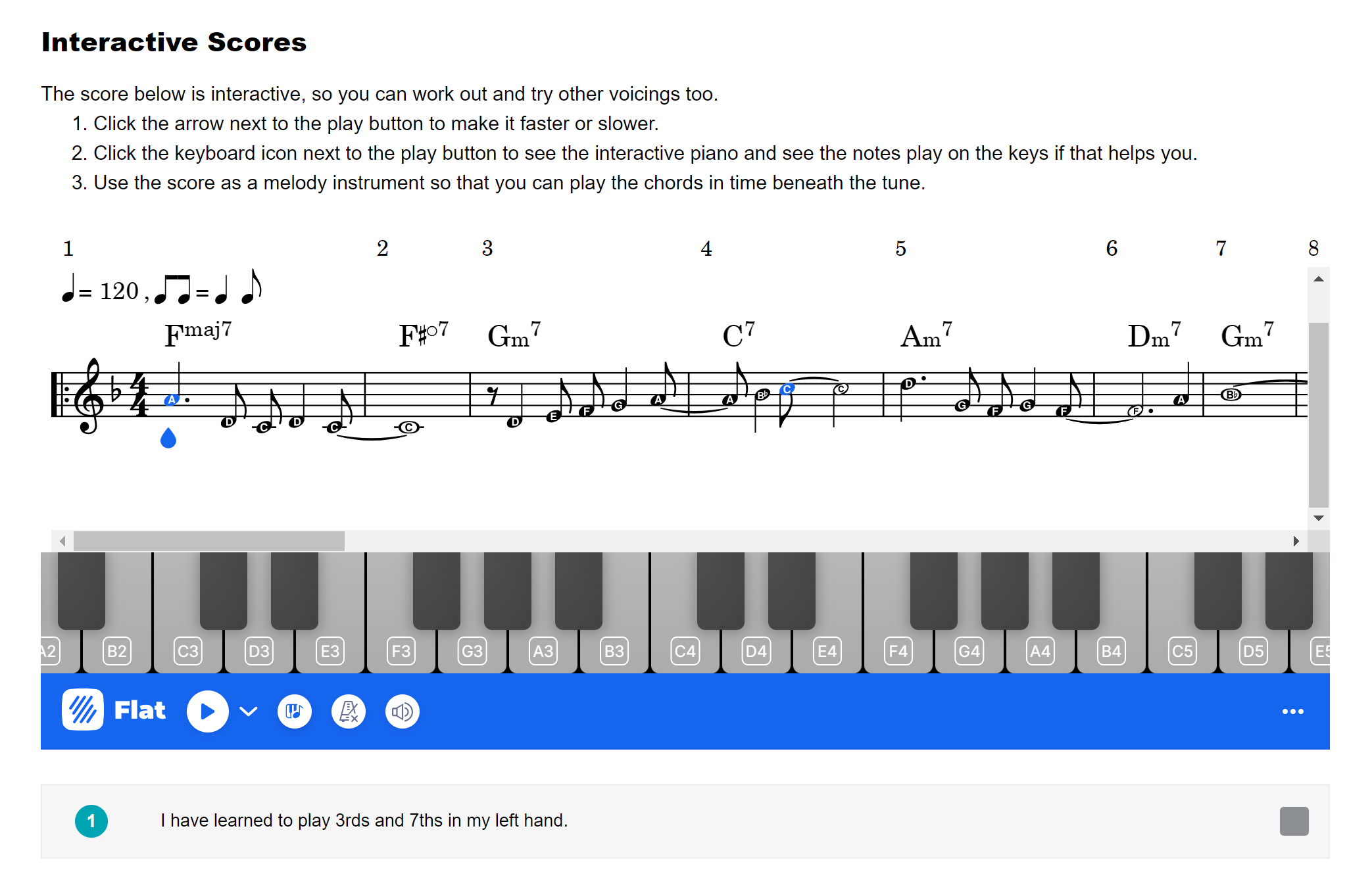
Sample Interactive Score
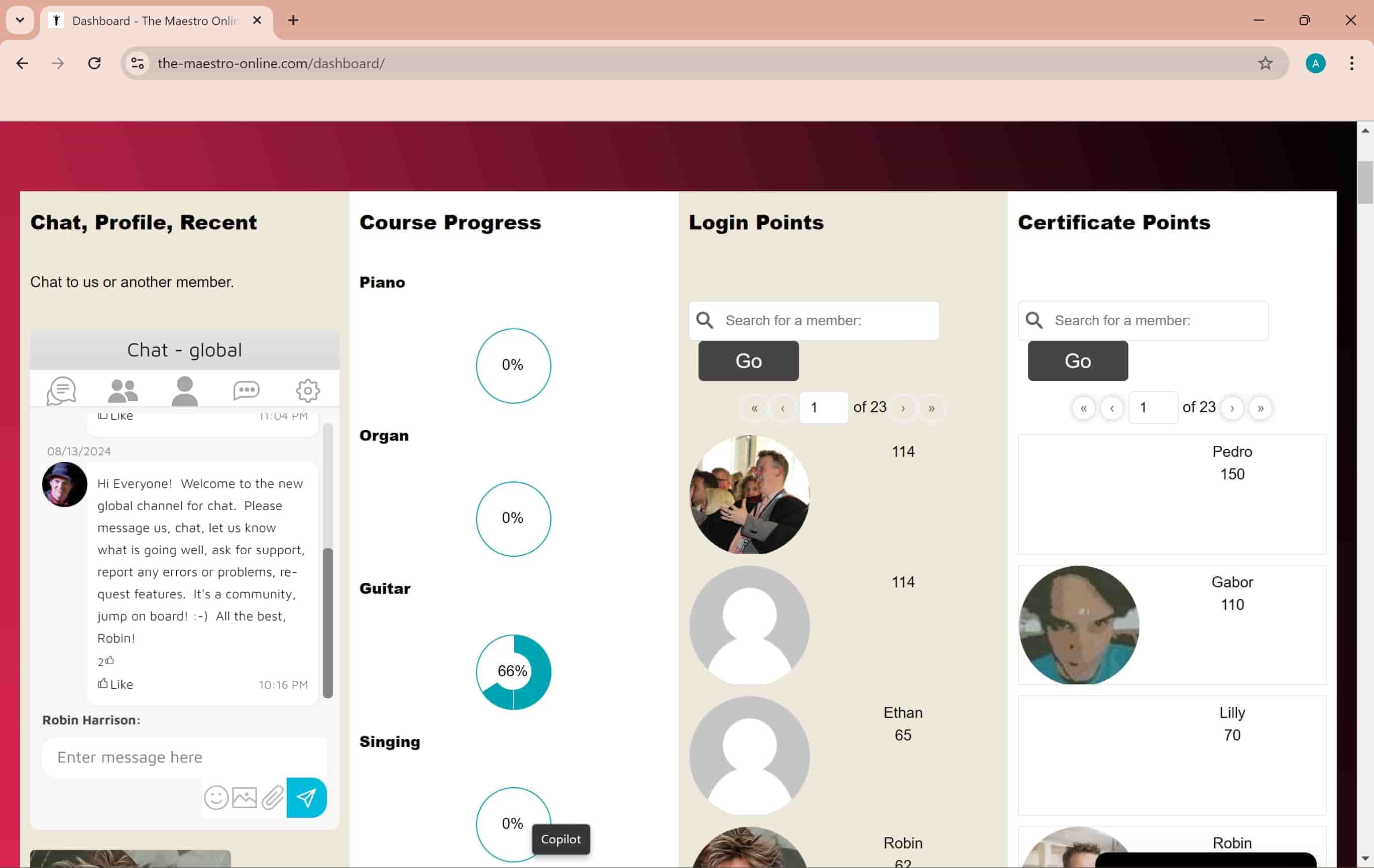
Course Dashboard with Progress and Points
Thorough Musicianship
Creativity, improvisation, and ear training are seamlessly integrated with popular, gospel, classical and jazz melodies to help you achieve true musical freedom.
Unique Learning Journey
Our tailored methodology emphasises improvisation and aural skills first, with notation used to support—not restrict—your creativity.
Certification
Courses include clear objectives, tasks, and fun quizzes that lead to downloadable certificates—perfect for motivation and recognition.
Gamification
Track your progress and climb the league tables by earning certificate points and logging in regularly.
️ Interactive Software
Our custom music software links visual notation with sound to enhance your creativity and understanding.
Celebrity Masterclasses
Learn from internationally acclaimed musicians and award-winning performers through high-quality video lessons and real-world demonstrations.
Expert Pedagogy
Each self-study course is structured with professional teaching principles, goal-setting, progress tracking, and step-by-step tasks.
Flexible Learning
Study from home, at your own pace. Affordable monthly fees and no need to travel—music learning that fits your lifestyle.
Human Touch
Get personalised support from our expert team and request custom courses tailored to your goals.
Personalised Experience
Receive bespoke course recommendations and guided learning plans based on your interests and skill level.
For All Levels
A wide range of self-study courses, celebrity masterclasses, and optional 1-1 lessons designed for adult and teenage musicians, university/conservatoire students, home schoolers, and music therapists.
________________________________________
A Quick Look at a Typical Masterclass Course
• Celebrity video lessons
• Objectives & exercises
• Progress tracking
• ️ Interactive music software
• Certificate on completion
(over £2000 of content included)
Reviews
There are no reviews yet.
Be the first to review “Improvise Sonata Form from 6 Jigsaw Pieces”

 Thorough Musicianship
 Unique Learning Journey
 Certification
 Gamification
 ️ Interactive Software
 Celebrity Masterclasses
 Expert Pedagogy
 Flexible Learning
 Human Touch
 Personalised Experience
 For All Levels
 A Quick Look at a Typical Masterclass Course
 Celebrity video lessons
 Objectives & exercises
 ️ Interactive music software
Reviews
There are no reviews yet.