How Do You Improvise Modal Music on Organ Like Langlais?
How Can I Learn Organ Improvisation from Langlais?
Learn organ improvisation from the direct line of Jean Langlais — motif by motif, ending by ending, until you can play a complete structured improvisation from start to finish.
This is Masterclass 2 of the Improvise Langlais series, taught by Dr Ann Labounsky — Fulbright scholar, 44-year professor at Duquesne University, AGO 2025 Distinguished Artist, and the last surviving student of Jean Langlais himself. Where Masterclass 1 established the modes, the chants, the harmonisation methods and the foundational forms, Masterclass 2 goes deeper: into the motive that drives an improvisation, the development section that builds it, the contrasting gesture that pivots it, and the ending that closes it with the open fifth that defines the Langlais sound.
What Will You Learn in a Langlais Organ Improvisation Method Masterclass?
Seven structured lessons take you from extracting a three-note motive from a Gregorian chant to assembling a complete modal organ improvisation — introduction, motivic development, contrast, and ending — in a form drawn directly from Ann’s study with Langlais at Sainte-Clotilde in Paris.
- The motif — Ann’s foundational rule: never take the opening notes. Search within the phrase for three or four notes chosen entirely by ear. This is where every Langlais improvisation begins.
- Motivic development — six techniques taught by Ann: transposition, voice shift, register change, paraphrase (pitch and rhythmic), inversion, and extension. The Lego principle: assemble blocks of development rather than inventing continuously.
- The development section — the rising-thirds sequence, D → F → A → C → E → G → B → D, one complete modal circuit. Pitch ascent, dynamic growth, and register opening combine to create irresistible forward momentum.
- The contrasting section — Ann’s two-gesture approach: a melodic arch over a sustained chord that travels into dissonance and returns; then a black-note cluster that resolves voice by voice into a pure triad — upper note first, each remaining voice finding its white-note home by step.
- Endings — quiet (motive with rallentando, open fifth on the final note) and dramatic (black-note clusters over a sustained pedal, releasing to a full eight-note open fifth across five octaves). Langlais’s governing principle: never the final chord — always the open fifth, arrived at by contrary motion.
- The complete improvisation — Introduction → Motive Statement → Development → Contrast → Ending. Know the form first. The form is the bones. The improvisation is a known shape, brought to life.
What are the Seven Interactive Modal Improvisation Apps?
Every lesson is paired with a purpose-built interactive app — not a quiz, not a drill, but a genuine compositional tool used in the same session as the video lesson and taken directly to the organ:
- Motive Finder — extract, hear and claim your motive from Ave Maris Stella by ear
- Motive Laboratory — six development techniques, timeline builder, Ann’s harmonisation, loop and save
- Quiet Ending Builder — three rallentando paths to the open fifth
- Big Ending Builder — three dramatic paths through black-note clusters to the eight-note close
- Development Builder — rising-thirds staircase with dynamic growth and printed practice map
- Contrast Builder — the melodic arch and four displaced-triad resolutions with voice-by-voice playback
- Improvisation Assembler — all components assembled into one complete improvisation, with proportion visualiser, full audio playback, and a practice map to take to the console
Your motive, your development sketch, your chosen ending, and your contrast gesture are all saved automatically as you work through the lessons. By Lesson 7, the Assembler pulls everything together and plays your improvisation back to you before you take it to the organ.
Who this is Organ Improvisation Masterclass For?
This course is designed for organists of intermediate to advanced level — church musicians, organ scholars, conservatoire students, and independent learners who want to move beyond reading notes and into the genuine creative tradition of the French organ school. It is equally well suited to pianists who play organ, and to teachers seeking structured, historically grounded improvisation material for their students.
If you are working toward our Creativity Grades — particularly the Organists Pathway — this masterclass addresses core improvisation competencies across multiple grade levels, from motivic development through complete structured improvisation (Grades 6–8). Every technique taught here maps directly onto the skills assessed in TMO’s Ofqual-accredited improvisation examinations.
New to the Improvise Langlais series?
Begin with Masterclass 1, which covers modes and chants, harmonisation methods (Ann’s and Dupré’s), foundational forms (ABABABA prelude, ABA, English voluntary, canon and fugue), and eight interactive apps including the Fugue Builder. Masterclass 2 builds directly on those foundations.
£19.99 — lifetime access — seven lessons — seven apps
What is The Maestro Online Difference for Organists?
This isn’t just a video, it’s a course with tasks, apps and interactive scores; it’s part of a holistic ecosystem. When you join, you’re not just getting a course—you’re joining a global community of creative musicians learning from the finest pianists and organists, improvisers and more in the world.
Frequently Asked Questions
Do I need to have completed Masterclass 1 before taking this course?
It is strongly recommended. Masterclass 2 builds directly on the modal harmony, chant vocabulary, and foundational forms taught in Masterclass 1. Students who begin here without that grounding may find the harmonisation content and the discussion of form harder to follow. If you are confident in D Dorian, know the Dupré progression, and have some experience with chant-based improvisation, you can start here — but Masterclass 1 remains the natural starting point for the series.
What level of organist is this course designed for?
Intermediate to advanced. You should be comfortable at the console, able to manage hands and pedals independently, and have some experience with modal or chant-based playing. The improvisation techniques taught here — motivic development, rising-thirds sequences, voice-by-voice resolution, open-fifth endings — are drawn from conservatoire-level pedagogy, but Ann’s teaching is always practical and immediately applicable. Advanced beginners who are serious about the French organ tradition will also find the course accessible.
Who is Dr Ann Labounsky?
Ann Labounsky is the world’s leading authority on the music of Jean Langlais. A Fulbright scholar, she studied directly with Langlais at the Basilica of Sainte-Clotilde in Paris, recorded his complete organ works across 26 CDs, and wrote the authoritative biography Jean Langlais: The Man and His Music (Amadeus Press, 2000). She served as Professor of Organ and Sacred Music at Duquesne University for over 44 years and was named AGO Distinguished Artist for 2025. What she teaches in this masterclass is the method as Langlais transmitted it — not adapted or reconstructed, but passed on directly.
What are the interactive apps and how do I use them?
Each of the seven lessons is paired with a purpose-built interactive app — a compositional tool, not a quiz. The apps let you extract and claim your motive, build a development sequence, hear your endings played back with correct rallentando and open-fifth voicing, and ultimately assemble a complete improvisation from all your saved choices. Your work carries forward automatically from lesson to lesson via your browser, so by Lesson 7 the Improvisation Assembler already knows your motive, your development steps, your contrast gesture, and your chosen ending. You then take the printed practice map to the organ.
Is this course relevant to the TMO Creativity Grades?
Yes. The techniques taught here map directly onto the improvisation competencies assessed across the Creativity Grades, particularly the Organists Pathway. Motivic development corresponds to Grade 5 skills; complete structured improvisation in a named form with development and contrast corresponds to Grades 6–8. If you are preparing for a TMO examination, this masterclass provides both the technical grounding and the structured practice tools you need. Visit the Creativity Grades page for full syllabus details.
Can pianists take this course, or is it exclusively for organists?
Pianists will benefit from the harmonic and structural content — the motive techniques, the development section, the voice-by-voice contrast gesture, and the complete form are all fully transferable. The open-fifth endings and some of the registration guidance are organ-specific, but the interactive apps work equally well at the piano. Pianists working toward TMO Creativity Grades in the piano pathway will find the motivic development content directly applicable.
How long does the course take to complete?
Each of the seven lessons combines a video masterclass with an interactive app session and organ practice tasks. Most students will spend between 45 minutes and two hours per lesson, depending on how much time they spend at the instrument between sessions. The course is designed for self-paced study with no time limit — your progress and saved app data remain available indefinitely.
Who is Dr Ann Labounsky?
Dr Ann Labounsky is the world’s leading authority on Jean Langlais’s organ music and improvisation pedagogy. She is the world’s leading authority on Langlais himself, and her 50+ year career has been devoted to preserving, interpreting, and teaching his compositional and improvisational methods.
THE LINEAGE
Labounsky studied improvisation directly with Jean Langlais in Paris from 1962 to 1964 on a Fulbright Fellowship. She was not a casual student; she was chosen by Langlais to learn his method at the highest level. She then spent three decades recording his complete organ works (26 CDs, 356 tracks), and authored the definitive English-language biography of the composer.
This is not scholarship at a distance. This is direct transmission. Labounsky learned by sitting at the organ next to Langlais, watching his hands, hearing his voice, internalizing his approach to improvisation. Everything she teaches in this course comes from that direct apprenticeship.
THE CREDENTIALS
Ann Labounsky studied with Jean Langlais at the Basilica of Sainte-Clotilde in Paris on a Fulbright Grant, learning his works from the composer at the organ where he served for decades. She recorded his complete organ works across 26 CDs — still considered the definitive recordings — and wrote the authoritative biography Jean Langlais: The Man and His Music (Amadeus Press, 2000). She served as Professor of Organ and Sacred Music at Duquesne University for over 44 years and was named AGO Distinguished Artist for 2025. What she teaches in this masterclass is not adapted or reconstructed: it is the method as Langlais transmitted it, passed on directly.
Education & Training
- B.M. and M.M. in Organ Performance, University of Michigan
- Studied organ with André Marchal at Sainte-Eustache, Paris (1962–1964)
- Studied improvisation with Jean Langlais at Sainte-Clotilde, Paris (1962–1964)
- Earned Diplôme de Virtuosité with mention maximum in both performance and improvisation at the Schola Cantorum, Paris (1964)
- Fulfilled her Fulbright obligation by studying at the highest levels of the French organ tradition
Performance & Recording Career
- Concertizing organist with performances across North America and Europe
- Performed at Notre-Dame Cathedral (Paris), Westminster Abbey (London), and major concert halls worldwide
- Recorded The Complete Organ Works of Jean Langlais (26 CDs, 1979–2003)
- 356 tracks, over 22 hours of music
- Recorded on 7 historic organs across the USA and France
- Recorded under Langlais’s direct supervision (1979–1987)
- Now considered the definitive cycle of these works
- Available through Voix du Vent Recordings, Organ Historical Society, and major streaming platforms
Teaching & Pedagogy
- Professor of Organ and Sacred Music, Mary Pappert School of Music, Duquesne University (1976–2020), now Professor Emerita
- Founded and directed sacred music programs at Duquesne; trained generations of organists and church musicians
- Director of the National Committee on Improvisation, American Guild of Organists
- Councillor for Education, American Guild of Organists
- Fellow of the American Guild of Organists (FAGO designation)
- AGO 2025 Distinguished Artist (the highest honour given by the American Guild of Organists)
Scholarship & Authorship
- Jean Langlais: The Man and His Music (Amadeus Press, 2000)
- 285 pages, comprehensive biography authorized by Jeannette Langlais (his widow)
- Combines biography, musical analysis, and pedagogy
- The definitive English-language resource on Langlais
- Used in organ studios and conservatories worldwide
- Published interview in The Diapason magazine (Andrew Scanlon, “A Conversation with Ann Labounsky”)
- Multiple peer-reviewed articles on Langlais, modal improvisation, and organ pedagogy
WHAT MAKES HER TEACHING UNIQUE
1. Direct Apprenticeship to a Master
Labounsky did not learn Langlais’s method from books or recordings. She sat at the organ with him in Paris. She watched his hands. She heard him explain his thinking. She improvised while he listened. This direct transmission—master to student—is irreplaceable.
When Langlais became too frail to teach formally (late 1980s), Labounsky had already absorbed his method so thoroughly that she could represent it faithfully in her own teaching. For 40+ years since his death, she has been the custodian of his improvisational pedagogy.
2. Deep Technical Understanding
Labounsky is not a performer who can play beautifully but cannot explain why. She has spent her career analyzing Langlais’s music, teaching organ students, and directing improvisation curricula. She understands not just how to improvise in this tradition, but why each principle works.
Her teaching breaks down complex concepts (modal harmony, motive development, form) into teachable, learnable patterns. She makes the invisible visible.
3. Commitment to Accessibility
Labounsky has always believed that this method should not be locked behind gatekeeping or mystique. She has made her recordings available through public channels. She has taught in university settings where students from all backgrounds could access her expertise. She has written clearly and comprehensively for English-speaking organists who may never travel to Paris.
This course reflects that same commitment: to make the Langlais Method accessible to organists worldwide, without diluting its rigor or depth.
HER RECORDED LEGACY
Labounsky’s 26-CD cycle of Langlais’s complete organ works stands alone as a pedagogical resource. Each recording:
- Uses different organs in different countries (each with distinct tonal colors)
- Demonstrates how the same work can be interpreted on different instruments
- Includes detailed booklet notes providing context for each piece
- Reflects interpretive choices made in consultation with Langlais himself
- Shows mastery of registration, phrasing, and improvisation in the Langlais style
These recordings are not historical artifacts. They are tools for learning. When Labounsky plays a Langlais prelude, she is demonstrating how to think through modal improvisation, not just performing a finished piece.
WHAT SHE BRINGS TO THIS COURSE
This masterclass is taught in Labounsky’s voice, using her pedagogical framework, drawing on her 50+ years of research and teaching. You are learning:
✓ Directly from the world’s leading authority on Jean Langlais ✓ From the world’s foremost interpreter of his organ works ✓ From someone who has taught hundreds of organists to improvise ✓ From someone who has analyzed every Langlais composition and can explain the compositional thinking behind them ✓ From someone who lives the philosophy she teaches: Ear first, theory second, spirit always
HER PHILOSOPHY
When asked how to teach improvisation, Labounsky says: “First, you must hear. Then your body learns. Only then does your mind understand. The spirit comes through all three.”
This is the approach you will experience in this course. Not formulas. Not rules. Not theory divorced from music. Instead: listening, playing, feeling, understanding.
It is the Langlais Method, transmitted through Ann Labounsky, now offered to you.
Our music masterclass courses are self-study digital courses embedded with information, interactive music software (scores), exercises, objectives, tasks, teaching pedagogy and videos of celebrities and international level musicians explaining and demonstrating key skills. Certificates are awarded at the end of each course.
🎵 Why Choose Our Music Learning Platform?
Unlock a rich, flexible, and inspiring music education experience designed for musicians of all levels. Whichever area of musical learning inspires you, our world-class performers offer it all.
A Quick Look at a Typical Masterclass Course
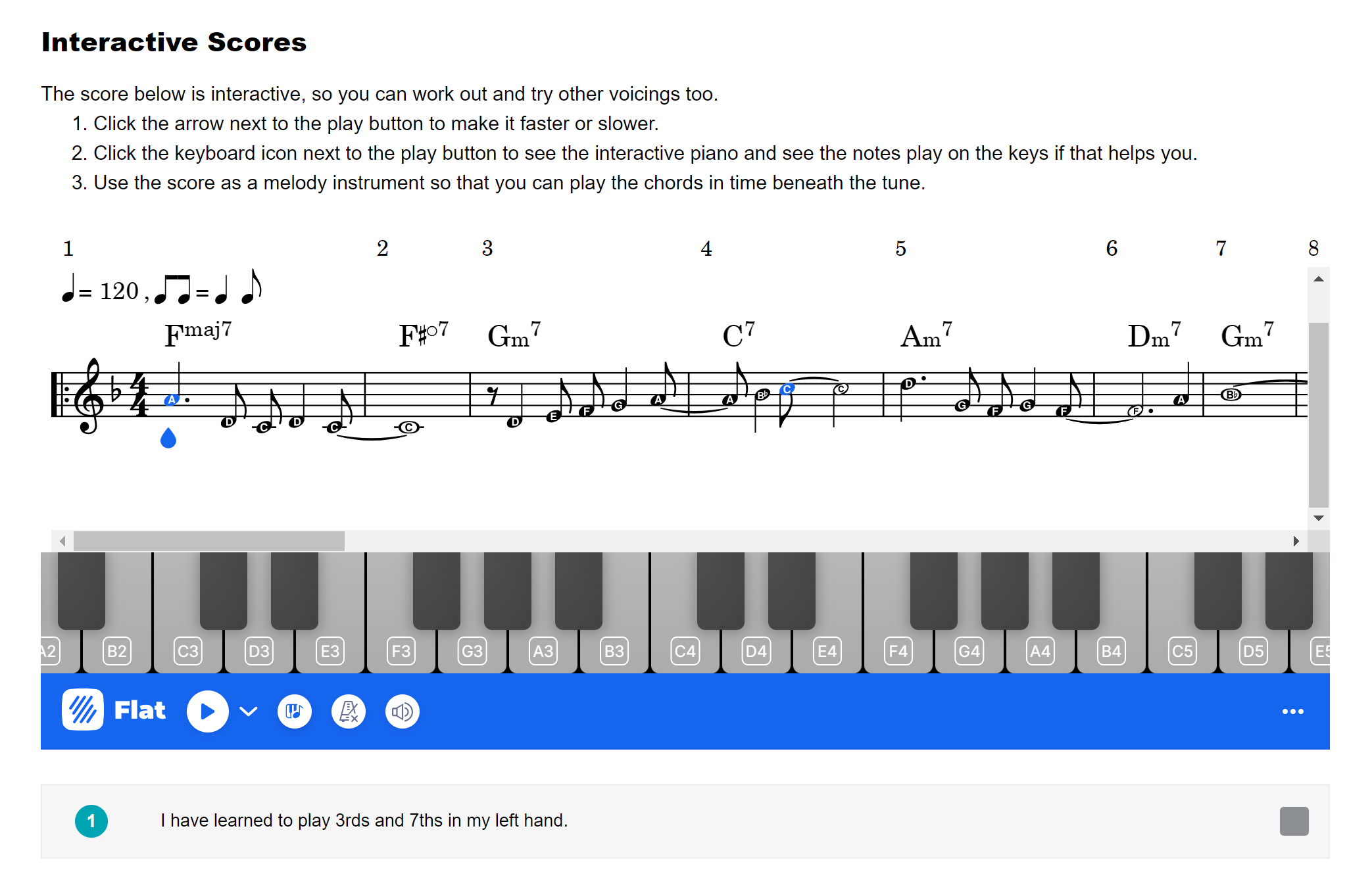
Sample Interactive Score
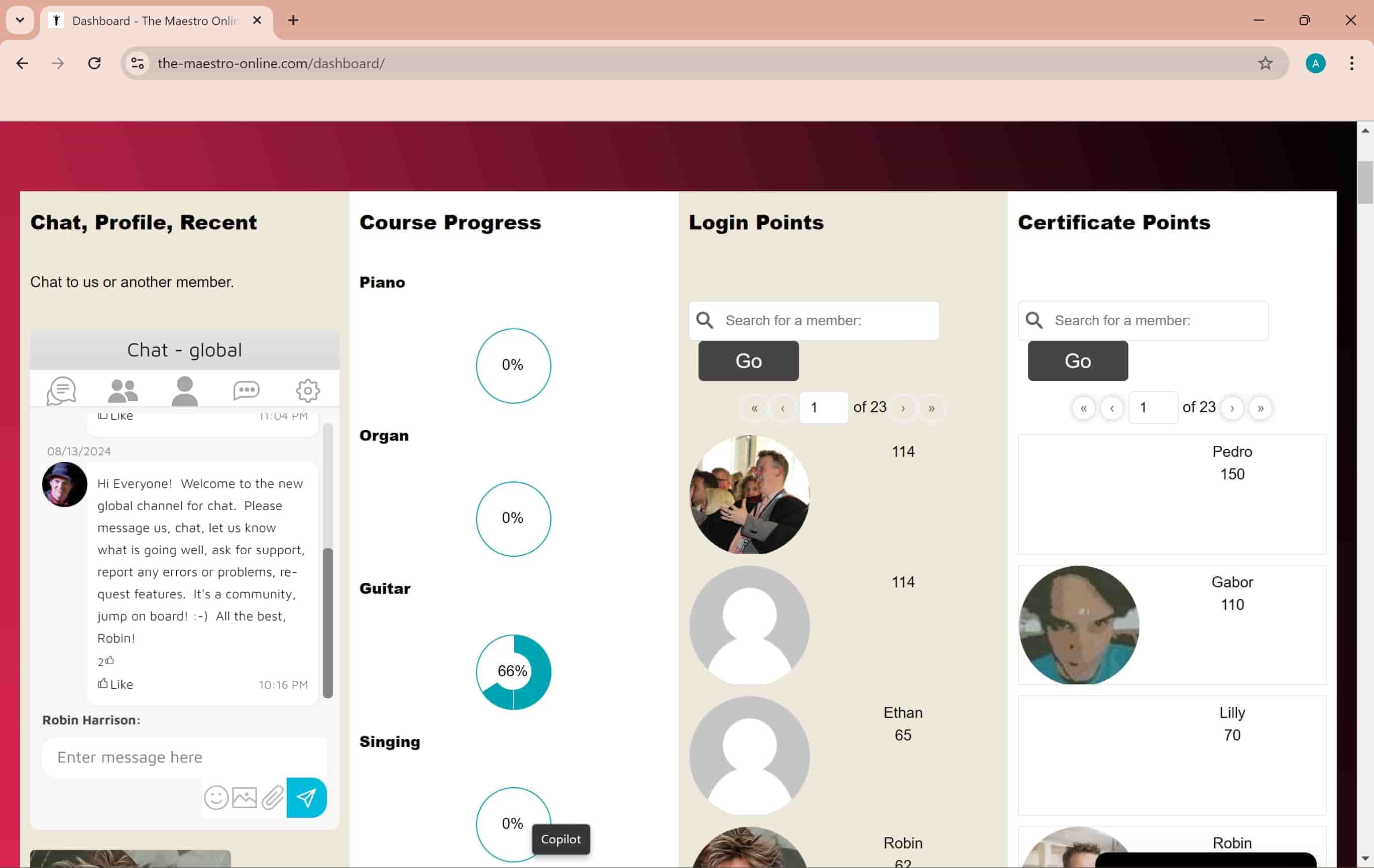
Course Dashboard with Progress and Points
 Thorough Musicianship
Creativity, improvisation, and ear training are seamlessly integrated with popular, gospel, classical and jazz melodies to help you achieve true musical freedom.
 Unique Learning Journey
Our tailored methodology emphasises improvisation and aural skills first, with notation used to support—not restrict—your creativity.
 Certification
Courses include clear objectives, tasks, and fun quizzes that lead to downloadable certificates—perfect for motivation and recognition.
 Gamification
Track your progress and climb the league tables by earning certificate points and logging in regularly.
 ️ Interactive Software
Our custom music software links visual notation with sound to enhance your creativity and understanding.
 Celebrity Masterclasses
Learn from internationally acclaimed musicians and award-winning performers through high-quality video lessons and real-world demonstrations.
 Expert Pedagogy
Each self-study course is structured with professional teaching principles, goal-setting, progress tracking, and step-by-step tasks.
 Flexible Learning
Study from home, at your own pace. Affordable monthly fees and no need to travel—music learning that fits your lifestyle.
 Human Touch
Get personalised support from our expert team and request custom courses tailored to your goals.
 Personalised Experience
Receive bespoke course recommendations and guided learning plans based on your interests and skill level.
 For All Levels
A wide range of self-study courses, celebrity masterclasses, and optional 1-1 lessons designed for adult and teenage musicians, university/conservatoire students, home schoolers, and music therapists.
______________________________
 A Quick Look at a Typical Masterclass Course
•  Celebrity video lessons
•  Objectives & exercises
• Progress tracking
•  ️ Interactive music software
• Certificate on completion

(over £2000 of content included)