Advent 19 - All I Want for Christmas

Keyboard Harmony & Chord Progressions
Understanding Keyboard Harmony
Keyboard harmony refers to the use of standard chord progressions on piano or organ, to create harmonious sounds that fit beneath melodies.
Key Components of Keyboard Harmony
1. Chords: Groups of notes played together, usually consisting of a root note, a third, and a fifth. Chords form the basis of harmony and are used to accompany melodies or create rich musical textures.
2. Chord Progressions: Sequences of chords that create musical sentences or phrases. Common progressions like the I-IV-V or ii-V-I are foundational in many musical genres. Chords are numbered according to which scale note forms their root. So, with the scale of C Major, chord I is C (CEG), chord ii is Dm (DFA), chord iii is E minor (EGB), chord IV is F Major (FAC), chord V is G Major (GBD), chord vi is A minor (ACE) and chord vii is B diminished (BDF).
3. Voicings: Different ways of arranging notes within a chord. Voicings can affect the mood and sound of the music simply by taking the same notes of a chord and playing them in different octaves or orders.
Techniques in Keyboard Harmony
1. Arpeggios, Alberti Bass, Walking Bass: These are all different types of elaborating a chord to create different textures. Arpeggios are very fluid and might move up and down (CEG high C GEC). An Alberti Bass is a Mozart favourite (CGEG). A Walking Bass makes you think of jazz (CEGABbAGEC).
2. Modulations: Chord progressions can be used to move a piece of music smoothly from one key to another. Changing key (say from C Major to G Major) creates contrast and is an important part of the larger scale structure of a song.
3. Improvisation: Creating music on the spot by spontaneously requires an understanding of keyboard harmony so that you have a range of chord progressions or musical sentences at your fingertips. The more you practice, the more you learn which notes sound best over a particular chord and you develop your own language. Will Todd’s Masterclass in the Masterclasses on this site talks about his “spice rack”, which notes to play above a chord to create a particular colour.
Why is Keyboard Harmony Important to Study?
Keyboard harmony is crucial for musicians, composers, and arrangers. It helps in understanding the structure of music, creating arrangements, accompanying other musicians, and composing original pieces.
Summary
Keyboard harmony is an essential skill for any keyboardist or musician. Mastery of harmonies, chords, and techniques enhances musical expression and creativity, enabling the creation of beautiful and captivating music.
Chord Progressions in All I Want for Christmas
Chromatic Scale, Circle of Fifths, Passing 6/4s
So, I always bang on about re-stylising songs. Here’s my version of All I Want For Christmas is My Two Front Teeth.
What have I explored?
(1) Elements of the chromatic scale occur in the melody (the chromatic scale allows you to explore all white and black notes)
(2) Circle of Fifths and a ii-V-I progression (Dm-G-C). D down to G is a 5th, or 5 notes (DCBAG) and G down to C is a 5th too (GFEDC). A more extended use of the circle of 5ths occurs later: E7-Am-D-G7.

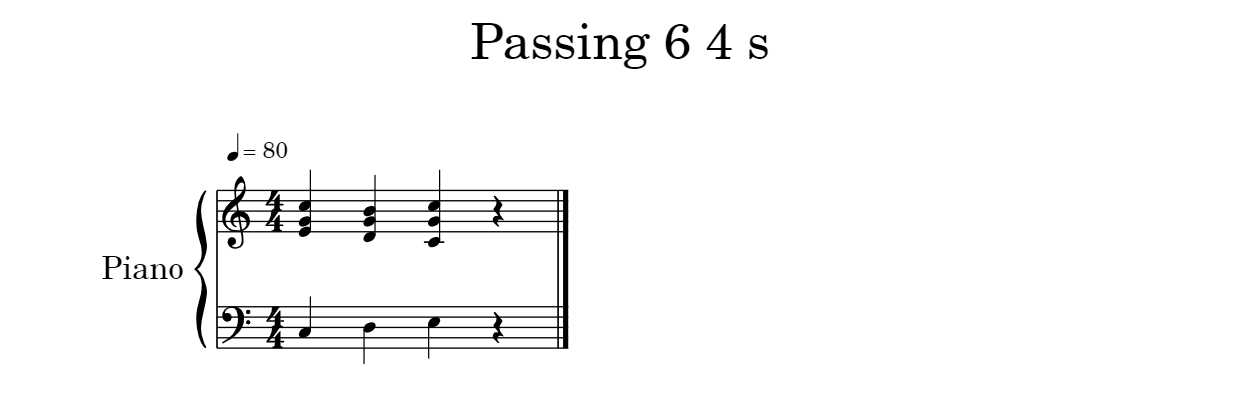
(3) Passing 6/4s. These are more complicated! Imagine a C Major chord with a C in the bass, then a C chord with an E in the bass. Now, put a note in between C and E – it’s D. Place a G chord over the D. The chord, from lowest notes to top, might have D in the bass, G above and B on top. D-G is a 4th and D-B is a 6th, so this is known as a 6-4 chord. We pass through the 6-4 chord when we move from C Major with a C in the bass, through G Major with a D in the bass (the 6-4 chord) to C Major with an E in the bass.