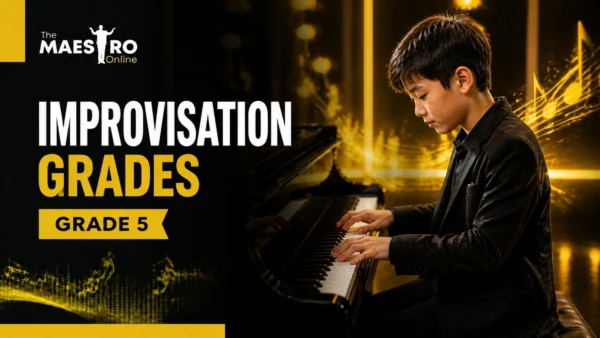
Piano · Organ · Harpsichord | The Music Lover’s Creativity Grades — Piano & Organ Improvisation Exams
What is The Maestro Online Grade 5 Improvisation Exam?
Qualification: TLM Level 2 Certificate in Musical Performance — Grade 5 (603/4579/2)
RQF level: RQF Level 2
UCAS points: None
Pieces required: 4 pieces: 1 Bass-Up (List A) + 1 Melody-Down (List B) + 1 EDI (List C) + 1 Creative Freedom (List D)
Duration per piece: 2.5 – 4 minutes per piece
Total exam time: Up to 16 minutes total
Price: £29
Results turnaround: Results in 1–5 working days (often 24 hours)
Eligible instruments: Piano, organ (pipe or digital), harpsichord, electronic keyboard (full-size, touch-sensitive, sustain pedal). Organists: minimum 2 manuals, swell pedal, registration changes in at least one piece.
What’s in the Grade 5 Improvisation Exam?
The TMO Piano & Organ Improvisation Grade 5 Exam introduces Theme and Variations as a structural form, the chromatic ground bass (Dido’s Lament by Purcell is the core reference), secondary dominants, and the full range of seventh chord inversions. The Monte, Fonte, Converging Cadence, and Rule of the Octave in a minor key all feature in the Mozart route’s extended Development Section. The Jazz-Gospel route introduces Rhythm Changes and walking bass with alternating 3rds and 7ths. Melody-Down repertoire at Grade 5 includes Gymnopedie No. 1, Traumerei by Schumann, Prelude Op. 28 No. 4 by Chopin, Blue Bossa, Autumn Leaves, Girl from Ipanema, and Pinetop’s Boogie.
The Organist route at Grade 5 asks for a Cantilena in the style of Rheinberger’s Sonata 11 Op. 148 — smooth, lyrical, with walking bass elements and subtle chromatic elaboration. The Familiar route produces a highly ornamented Baroque Andante inspired by Fiocco’s Pieces de Clavecin Opus 1. The EDI list at Grade 5 includes Clara Schumann’s Scherzo No. 1, Fanny Mendelssohn’s Melodie in C# minor, Angeline Bell (Malaysian female composer), Freedom In Unity by Joshua Pulumo Mohapeloa (Lesotho), and Canciones Mexicanas by Manuel Ponce.
Frequently Asked Questions
Q1: What are the Fonte and Converging Cadence schemas?
A: The Fonte (‘source’) is a galant schema involving a characteristic stepwise descent with a change of mode, creating a sense of harmonic contrast between two phrases. The Converging Cadence brings two voices together from contrary motion to a unison or octave. Both are part of the Classical-era partimento vocabulary introduced at Grade 5.
Q2: What does the Ground Bass route involve at Grade 5?
A: The Ground Bass route at Grade 5 asks for improvisation over a chromatic bass — specifically Dido’s Lament from Purcell’s Dido and Aeneas (Z.626). The candidate creates a lyrical, reflective melody that can start mid-phrase and overlap the bass repetitions, as was common in Baroque lament tradition.
Q3: What walking bass techniques are introduced at Grade 5?
A: The Jazz-Gospel route introduces walking bass with voicings that alternate 3rds and 7ths, Rhythm Changes, and more complex rhythmic patterns. This is accompanied on the Melody-Down list by Autumn Leaves (with Sarah Cion’s Walking Bass Masterclass) and Blue Bossa.
What’s in our Piano, Organ & Harpischord Improvisation Syllabus Lists and What Learning Resources are there?
→ List B (Melody-Down) Overview
→ Previous grade: Grade 4
→ Next grade: Grade 6
Reviews
There are no reviews yet.